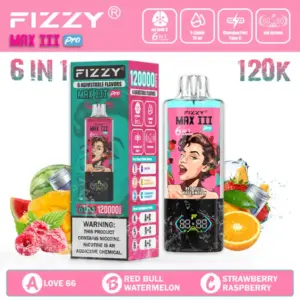


WASPE Aiviou 150K Puffs
In Stock
Original price was: €18.74.€12.74Current price is: €12.74.32% OFF
You save

We ship your order quickly and reliably with
DHL, including
tracking.
The exact delivery time depends on the warehouse status (EU warehouse / international warehouse).
描述
First impressions after a season with the Aiviou 150K
I have been carrying one of these since late spring, long enough to empty two of its three chambers and to stop reading the number on the box as a promise. What follows is what I would tell someone holding the device at a counter: the figures our sheet actually fixes, how far 64 ml stretches in ordinary use, which of the twelve trios suits which palate, what each of the six collar stops does, and how to look after the cell and the liquid.
The WASPE Aiviou 150K puffs device is a pre-filled, rechargeable bar with a clear body, a small screen on the front face and a rotating collar set into the base. It is squared off and dense rather than slim, and the weight is the honest clue that most of the inside is liquid. Nothing needs assembling and nothing needs filling: one sealed unit leaves the display box, the collar picks the chamber, and the first draw is ready once the wick has taken up liquid.
What the specification sheet fixes, and what it leaves open
These are the values our sheet publishes for this model. The third column usually goes missing on competitor pages, and it is the one that decides how the unit behaves on a shelf, in a pocket or on a freight plan.
| Parameter | Figure on our sheet | What it changes for you |
|---|---|---|
| Model | WASPE Aiviou 150K, 6-in-1 switchable | Three chambers and six selectable routes instead of one tank and one taste |
| Puff rating | Up to 150,000 puffs, the maker’s figure | A laboratory-style ceiling rather than a count you will reproduce; see the planning band below |
| E-liquid | 64 ml, pre-filled | Roughly thirty times the liquid in a 2 ml bar, so one unit outlasts a weekly buying habit |
| Chambers | Three sealed chambers | Each holds its own liquid, so a single-flavour draw stays clean |
| Coil | 1.0 ohm mesh, one per chamber, three in total | A chamber past its best cannot drag the other two down with it |
| Cell | 650 mAh, rechargeable | A top-up cell rather than an all-week one, so plan the port into your routine |
| Charging | USB Type-C port | A standard phone cable works; no dedicated charger is needed |
| Screen | LED readout, battery charge and liquid level | The liquid half is the useful half: it follows the chamber the collar has selected |
| Strengths | 0 % / 2 % / 5 % | Fixed when the unit is made, one strength to a unit |
| Flavours | Twelve three-flavour trios | The trio is fixed too, so the pack decides what you live with |
| Size and weight | 53 x 46 x 138 mm, approx. 140 g | A jacket or bag pocket, not a shirt pocket |
| Trade packing | 10 units per display box, 160 per carton, approx. 23 kg gross | Freight and shelf planning; a single-unit buyer can skip this row |
What the sheet leaves open
Four things buyers ask about are not on our sheet at all, so this page does not state them either. There is no published charge time; sellers quote anything from about half an hour to over an hour, and none of those figures is a measurement of this unit. There is no published split of the 64 ml between the three chambers, which is why no per-chamber volume appears here. There is no list of what else sits in the box beyond the device itself, so no cable, manual or spare part is claimed. And there is no figure for how many draws one charge gives; the two numbers we found for that are shop copy rather than testing.
Where other listings drift
Most of the disagreement in this category is recycled copy rather than a revised device, and it helps to know which figure belongs to another model.
- One listing prints 65 ml; our sheet and the maker’s own page both say 64 ml.
- Another prints a 2 % / 3 % / 5 % ladder; the sheet states 0 % / 2 % / 5 %.
- A footprint of 47 x 47 x 118 mm, and weights running from 137 g to 170 g, travel between pages. That footprint belongs to the smaller 4-in-1 100K from the same line; our own sheet gives that model a shell of 47 x 47 x 118 mm, with a unit weight near 142 g.
- One page describes six chambers while its own text describes three tanks with three coils. Three chambers are what the sheet fixes; six is the number of routes they create.
If you are planning shelf space or freight, work from the 53 x 46 x 138 mm body and the 140 g unit weight, and treat the rest as a rounding difference borrowed from a smaller model.
What the 150,000-puff rating covers in real use
A rating with five figures behind it describes a laboratory: a fixed draw length, a fixed pause between draws, ideal conditions throughout. It is the ceiling of the hardware, not a count anyone reaches in an ordinary week.
The honest way to plan is from the liquid, not from the rating. Published consumption estimates for this class of low-power device sit between about 200 and 300 draws per millilitre, and across a 64 ml reservoir that works out at somewhere between about 13,000 and 19,000 draws for the whole life of the unit. Independent bench work on comparable high-capacity disposables has measured real draw counts well below the advertised figure, one test recording 1,200 draws against a 2,100 rating, or 57 % of it. Treat the headline as the maker’s maximum and the band from the liquid as your planning number; neither is a measurement of the unit in your hand.
| How you vape | Draws in a typical day | What one 64 ml unit covers |
|---|---|---|
| Occasional | Fewer than 150 | Many months, with the trio rotating slowly |
| Moderate | 300 to 400 | A few months on a single unit |
| Heavy, all day | 700 and up | Weeks rather than months, with top-ups between |
To see how this model sits against the other high-capacity devices we stock, the 150K puff range is the like-for-like comparison.
What moves the estimate
Long, slow draws move far more liquid than short ones, which is why two people with the same unit can be a month apart. Cold thickens the liquid and makes the coil work longer for the same mouthful; a warm car does the opposite kind of damage, thinning the liquid and pushing it at the seals. Charging habit matters as well, because a cell topped up little and often tends to hold its capacity better than one flattened to nothing every day.
Which of the twelve flavour trios to recommend, and to whom
Each unit carries three flavours and the collar turns them into six experiences, so the trio is the one choice that cannot be changed later. The twelve packs fall into loose families, and the third column is the one a shop needs when a customer asks what to start on.
| Trio | Chambers 1 / 3 / 5 | Palate it suits |
|---|---|---|
| 1 | Watermelon Ice / Lemon Lime / Lemon Peach | Cooling fruit, the easiest step up from a single-taste bar |
| 2 | Blueberry Ice / Strawberry Kiwi / Cherry Strawberry Ice | Cooling fruit with a berry base |
| 3 | Red Bull Ice / Raspberry Pomp / Sour Mango Strawberry | Energy drinks and sharp fruit |
| 4 | Strawberry Watermelon / Juicy Peach Ice / Triple Berry Ice | Soft fruit with a chill behind it |
| 5 | Cherry Cola Ice / Strawberry Red Bull Ice / Watermelon Raspberry | Dark, fizzy and sweet |
| 6 | Grape Ice / Blue Razz Cherry / Strawberry Ice | Cooling fruit, grape-led |
| 7 | Mixed Berries / Black Dragon Ice / Strawberry Cherry Cola | Berries and cola, the quieter end of the dark set |
| 8 | Fizzy Cola Ice / Energy Drink / Cherry Ice | Cola and energy, straight down the middle |
| 9 | Strawberry Banana / Kiwi Watermelon / Coconut Strawberry | Soft, rounded and tropical |
| 10 | Red Bull Cola Ice / Strawberry Raspberry Cherry / Blackberry Dragon Fruit | Dark fruit with an energy edge |
| 11 | Strawberry Watermelon Bubblegum / Sour Mango Ice / Strawberry Grape Ice | Candy and sour, the sweetest set here |
| 12 | Melon Passion Fruit / Blackberry Ice / Apple Kiwi | Fresh, green and light |
The trio I would hand over first
Trio 1, the watermelon, lemon lime and lemon peach set. All three flavours stand up on their own, the two blends it creates are citrus-sharp rather than heavy, and the cooling survives the mix, which is exactly what someone moving up from a single-taste bar is looking for. If grape and berry sound better than melon, trio 6 is the alternative.
For a dark, fizzy palate
Trios 5, 7, 8 and 10 are the cola and energy end of the list. Trio 8 is the most direct of the four: fizzy cola on one chamber, energy drink on the next, cherry ice behind both, and the blends land close to a cold soft drink. Trio 7 is the same family with more depth and less fizz, which makes it the easier one to use every day.
The rest of the WASPE range uses the same trio idea in smaller shells, which is worth a look if 64 ml is more unit than you need.
The selector collar: six stops out of three chambers
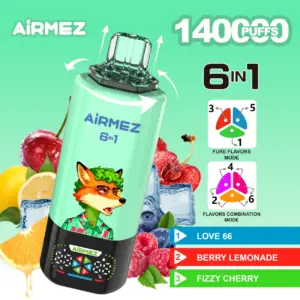
The collar in the base indexes through six stops. The odd stops open one chamber; the even stops open that chamber and its neighbour together. Nothing is refilled and nothing is swapped, and the six tastes come out of three lots of liquid.
| Stop | Chambers open | What the draw is like |
|---|---|---|
| 1 | Chamber one | The first flavour on its own, the way to judge it honestly |
| 2 | Chambers one and two | A blend of the first two, softer than either alone |
| 3 | Chamber two | The middle flavour alone, usually the sharpest of the set |
| 4 | Chambers two and three | The middle flavour rounded off by the last one |
| 5 | Chamber three | The last flavour alone |
| 6 | Chambers three and one | The last flavour meeting the first, the widest of the three blends |
That sequence is the maker’s own, and it is how three chambers produce six tastes without a sixth tank. Blending is also the quickest way to empty the unit evenly, because two chambers drain together instead of one running dry while the others sit full.
Your first draw
Take two or three short draws after the unit comes out of the box so the wick can take up liquid, then set the collar where you want it. Turn it slowly until it settles into a stop rather than forcing it past one. If you have just charged the unit, let it stand upright for a minute before the first draw.
The one setting you will actually adjust
The collar, and nothing else. There is no airflow ring, no power button and no screen menu to learn. Choose an odd stop when you want to judge a flavour on its own, and an even stop when you want the two next to it in the same mouthful.
What the readout is telling you
The screen shows the charge left in the cell and the liquid left in the selected chamber. Rotate the collar and the liquid reading follows the chamber, which is how you can tell at a glance which of the three is closest to empty. That is the reason you do not have to guess, and it is the half of the readout worth watching.
Charging and storage: looking after the cell and the liquid
Nothing on this unit is serviceable, so the two things you control are how you charge it and where it lives between draws.
| Habit | What works better | Why it matters |
|---|---|---|
| Charging | Short top-ups through the Type-C port | A cell kept in the middle of its range holds up better than one run flat every day |
| Charger | A plain wall plug | The port sets the pace, so a fast-charge brick adds nothing |
| Storage | Upright, cool and out of direct sun | Liquid thins in heat and thickens in cold, and both change the draw |
| Carrying | A jacket or bag pocket | At 140 g and 53 x 46 x 138 mm it will pull at a shirt pocket |
The charging routine
At 650 mAh this is a top-up cell rather than a week-long battery, so the Type-C port belongs in the routine instead of being kept for emergencies. A short charge in the morning covers a normal day. Topping up is kinder to the cell than flattening it and charging from nothing, and there is no benefit in leaving it plugged in for hours after the readout is full.
Storing a part-used unit
Keep it upright, so the liquid sits against the wick rather than against the seals, and keep it clear of a hot car, and out of a sunny windowsill. A unit that has been opened and used daily ages faster than one left whole, so if you rotate between several devices, keep the spares sealed until you need them.
Is this the right unit for you, and who should buy something smaller
This is a large, heavy, multi-flavour device built for someone who wants variety across weeks rather than one taste in the smallest possible shell. The table is the short version of that judgement.
| This unit earns its place if | Look at something else if |
|---|---|
| You tire of one taste long before the liquid runs out | You have one flavour you never get bored of |
| You would rather buy once every few months than once a week | You want something you can forget about in a shirt pocket |
| You want three flavours and their blends from one unit | You want a single fixed taste and nothing to adjust |
| You are happy to top up a small cell over Type-C | You expect a cell to last a week between charges |
| You like the idea of building a two-chamber blend on demand | You would never turn the collar off the single stops |
Questions buyers ask before the first order
Is the liquid replaceable, or is the unit sealed for good?
Sealed. The sheet lists the 64 ml as pre-filled and there is no fill port, pod or bottle to swap, so the part that recharges is the cell and not the liquid. Once the three chambers run out, the unit is done.
What comes in the box besides the device?
Our sheet describes one sealed unit per pack and names nothing else, with no cable, manual or spare part listed. That is a gap in our own specification rather than a statement that nothing else is there, so if a cable matters to you, ask before ordering and we will check the box instead of guessing.
Do I have to finish a chamber before switching?
No. Each chamber and its own coil are separate, and the collar only moves the airway. A part-used chamber can sit for days and be picked up again without losing anything, and nothing crosses from one chamber into another unless you choose an even stop.
What should we do if a unit arrives damaged?
Check the consignment when it lands and raise anything damaged or dead before you sign it off, so that it is settled on the same order. Our sheet describes no repair process, and nothing inside a sealed unit is user-replaceable.
How does this compare with the smaller WASPE multi-flavour models?
The 4-in-1 100K sits in a smaller shell of 47 x 47 x 118 mm, about 142 g, with four single routes and no blending at all. The 3-in-1 60K holds 54 ml across three chambers with 0.9 ohm coils, so it draws warmer. The Aiviou keeps 64 ml in three chambers of 1.0 ohm mesh, and it is the one of the three that will blend two chambers on demand.
How long can a unit sit unused?
Our sheet publishes no shelf figure, so we will not invent one. In practice a sealed unit lasts best if it stays upright somewhere cool and dry, out of direct sun, and once you have started on a chamber it is that chamber’s liquid that changes first, so leave the collar on a chamber you have already emptied if the unit is going into a drawer for a while.
Ordering for a shop, a counter or a reseller
This last part is written for trade buyers: shops, resellers and anyone restocking a display. A single-unit buyer already has everything they need above this line.
Packing runs in three steps. One sealed unit, a display box of ten, and a carton of sixteen boxes, which is 160 units at roughly 23 kg gross. A display box holds one trio at one strength, so a mixed order is built from whole boxes; we do not open a box and split it.
What to settle before the order goes in
Four things decide whether a consignment moves cleanly, and all four are worth agreeing in writing first: the trios and strengths you want, how many boxes of each, the carton count together with the freight weight you are budgeting for, and the delivery address with the window you need. Timing is quoted against live stock when the order is placed rather than promised in advance.
How the figure is set
Every order is quoted individually, because the number depends on how many boxes, which trios and where it is going, and the live figure appears at checkout. That is also why no amount is printed anywhere on this page: a figure written into a description stops being true the moment a quantity band moves, while the checkout is always current.
After dispatch
Once a consignment has left the warehouse the order is complete and cannot be recalled, which is exactly why the checking happens before it ships. Open and inspect on arrival, and raise anything damaged or short before you sign the delivery off rather than afterwards.
The puff count, liquid volume, coil, size and packing data on this page come from the manufacturer and are quoted exactly as the maker states them; we have not measured them independently.
Additional information
| Flavors | watermelon ice & lemon lime & lemon peach, blueberry ice & strawberry kiwi & cherry strawberry ice, red bull ice & raspberry pomp & sour mango strawberry, strawberry watermelon & juicy peach ice & triple berry ice, cherry cola ice & strawberry red bull ice & watermelon raspberry, grape ice & blue razz cherry & strawberry ice, mixed berries & black dragon ice & strawberry cherry cola, fizzy cola ice & energy drink & cherry ice, strawberry banana & kiwi watermelon & coconut strawberry, red bull cola ice & strawberry raspberry cherry & blackberry dragon fruit, strawberry watermelon bubblegum & sour mango ice & strawberry grape ice, melon passion fruit & blackberry ice & apple kiwi |
|---|